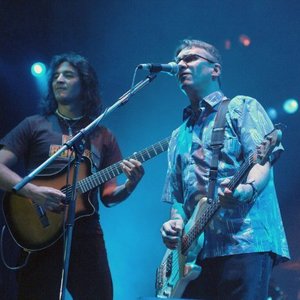
Formed in 1979 by vocalist/bass and keyboard player Marciano Cantero, guitarist Felipe Staiti, and drummer Daniel Piccolo, Los Enanitos Verdes began by playing shows around the area of Mendoza. After making the move from Mendoza to Buenos Aires in the hope of raising their exposure and playing more shows, the band enlisted the help of guitarist and vocalist Sergio Embrioni and keyboard player Tito Dávila in 1984. Los Enanitos Verdes’ debut self-titled release arrived in 1984 on the label Mordisco. The album spawned the hit single “Aún sigo Cantando”, however marked the departure of Embrioni a year later.
The band’s follow-up, 1986’s “Contrareloj” produced by Andrés Calamaro, saw Los Enanitos Verdes cover more original ground and produce the hits “Tus Viejas Cartas”, “Cada vez que digo Adiós”, and “La muralla Verde”. Produced by Calamaro once again, the band’s third album “Habitaciones extrañas” was issued by Sony Music in 1987. A year later, Los Enanitos Verdes issued the album “Carrousel”, and began an extensive tour of South America including a show at the popular Viña del Mar Festival. Soon after the band broke up with Marciano Cantero embarking on a solo career.
In 1992 Los Enanitos Verdes returned to the scene and recorded “Igual que Ayer” issued by EMI later that year. The platinum selling “Big Bang” was released in 1994, a year before the group participated in the Billboard Latin Forum Showcase in 1995. The band subsequently released the compilation “20 Grandes Éxitos” in 1995, the candid “Guerra Gaucha” in 1996, “Planetario” in 1997, “Tracción Acústica” in 1998, and the Grammy-nominated “Néctar” in 1999. In 2000 Los Enanitos Verdes toured alongside Molotov, Aterciopelados, and Café Tacuba as a part of the 17-date Watcha Tour. The album “Solo para Fanáticos” arrived in 2001, followed by “Amores Lejanos” in 2003, the live album “En Vivo” in 2004, “Pescado Original” in 2006, “Inéditos” in 2010 and “Tic Tac” in 2013.
Formed of vocalist and guitarist Andrea Escheverri and bassist and producer Héctor Buitrago, Aterciopelados, earliest incarnation drew on Buitrago’s hardcore punk influences, which led to their debut album “Con El Corazón en la Mano” (With my Heart in my Hand) in 1994. The album showcased Andrea Escheverri’s powerful voice, which was notably influenced by her mother’s singing of boleros, rancheras, and tangos when she was a child.
Aterciopelados’s sophomore album, 1995’s “El Dorado” (The Golden One), spawned the single “Bolero Falaz”, which proved to be the band’s breakthrough song thanks to considerable exposure on MTV across Latin America. After the release the band welcomed drummer Alejandro Duque and guitarist Alejandro Gómez Cáceras to the mix, who recorded on Aterciopelados’ third full-length “La Pipa de la Paz” in 1997. The album was notably less punk-rock and more electronic that its predecessors and took significant influence from traditional Colombian and Latin American themes. “La Pipa de la Paz” represented the band’s breakthrough into North America, and paved the way for their fourth full-length “Caribe Atómico” in 1988.
By this point Aterciopelados was essentially the musical excursions of Escheverri and Buitrago, and their 2000 album “Gozo Poderoso” became their most acclaimed album to date. The record debuted in the Top Ten of the Billboard Latin Albums sales chart and earned the band a Latin Grammy for Best Rock Duo/Group with Vocal.
During a five-year hiatus from releasing any original material both Escheverri and Buitrago released solo albums, the former of whom was awarded with a Grammy nomination. Following a move to the label Nacional, Aterciopelados returned in 2006 to release the album “Oye”, which won the Premio Lo Nuestro award for Album of the Year, and a Latin Grammy for Best Alternative Album. With the success of the acoustically-inclined “Oye” Aterciopelados released the similarly-sounding “Rio” in 2008. The album was produced by Héctor Castillo, known for his work with Brazilian Girls and David Bowie, and it noted and respected for its socially conscious approach to songwriting.
Argentinian rock outfit Los Enanitos Verdes or Little Green Men for the non-Spanish speakers can boast a career spanning over three decades of relative commercial success. They have been on the road for a similar amount of time and this really shows when they perform as they have crafted a stadium sized live show to compliment the large scale of their music.
Everything is grand from the offset, the moody lighting and explosion of white light beckons the quartet onto stage which is soundtracked to the roar of excited fans. Marciano Cantero takes it all within his stride and does a victory lap of the stage beckoning for even more noise before they begin. The quartet who remain unchanged all these years later go about recreating a setlist reaching from all of their previous albums and delight fans with note perfect renditions of material old and new. Although the baiting and swagger may seem a little over the top, luckily for Los Enanitos Verdes they have the music to back up the boldness and the audience to cheer them all the through.
This South American venue is all about one band tonight, non other than Aterciopelados, a band who are Colombia natives. Their name is pretty darn difficult to type write and say never having said it before, but to these patrons this evening, it’s on the tip of their tongue tonight. I’m just thinking about the encore!
Seriously though, this band are a global phenomenon having bred their own style of rock music, which has a bit of a hint of traditional Latin American music in there somewhere. They have managed to win three Latin Grammy Awards too, solidifying their amazing reputation of one of the top 10 contemporary global band in the music world of the present day.
Tonight they perform with such a great prowess as thought they’ve been around the block a few times and they know exactly what they’re doing. They play with great angst and virtuosity. Definitely worth looking these Colombian rockers up.